
When we think about MCP, think USB-C for AI. Just like USB-C lets any device plug into any charger or accessory, MCP standardizes how AI models (like Claude or ChatGPT) connect to external tools, databases, and services. With MCP AI Apps and tools speak a common language, making integration faster, secure and scalable.
- MCP Host: The AI-powered app (e.g., Claude Desktop, VS Code)
- MCP Client: The bridge that connects the host to a server.
- MCP Server: Provides access to tools, data, or actions.
Key market players include Anthropic-Creator MCP and Claude AI, OpenAI-Adopted MCP for agentic workflows, Microsoft, Diffusion Data, and Microchip Technology.
MCP Streamlines and a shared language enable seamless communication between systems; below is a visual showing MCP's benefits for agentic AI.
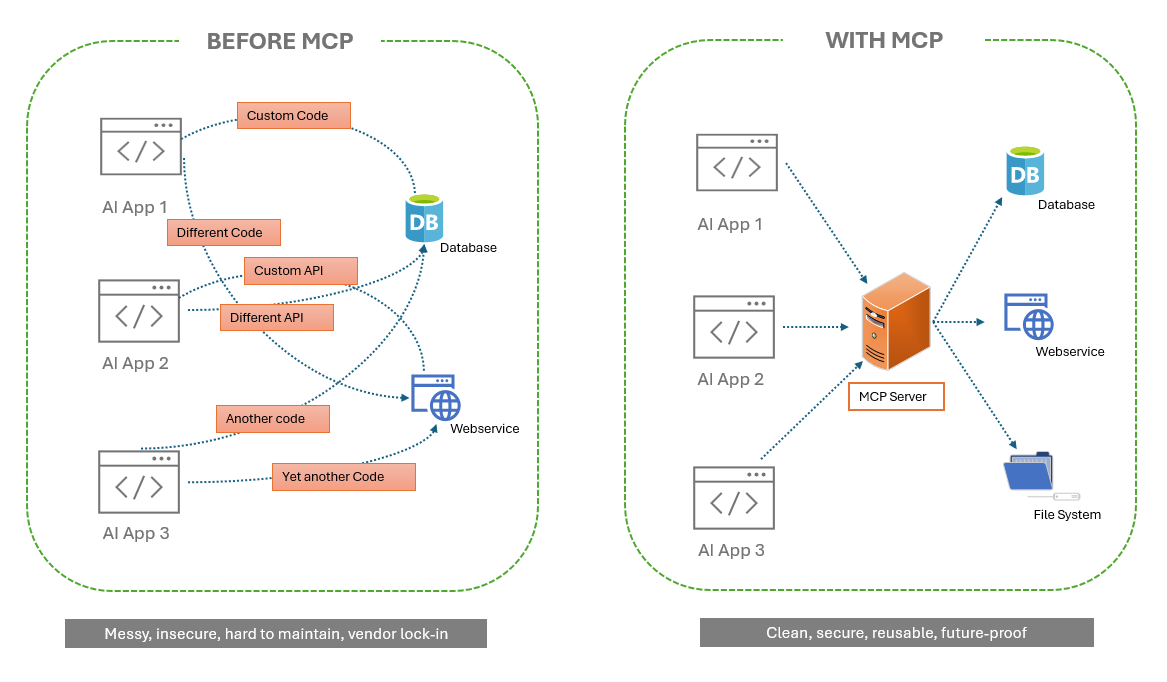
Standardization enables the use of a single protocol across all tools and models, streamlining communication and reducing fragmentation. This approach enhances scalability by simplifying integration complexity from a matrix of M×N connections to a more manageable M+N, making it easier to connect multiple models with multiple tools. Real-time access empowers AI systems to fetch live data from databases, APIs, and other sources, ensuring up-to-date responses and dynamic decision-making. Security is also strengthened through structured schemas, which help mitigate risks like prompt injection by enforcing consistent data formats. Finally, this unified framework supports cross-industry applications—from healthcare diagnostics to customer support—demonstrating its versatility and broad impact.
Despite its advantages, this approach faces several challenges. Immature governance remains a concern, as there is currently no formal standards body to oversee protocol development and ensure consistency across implementations. Security risks are also significant—misconfigured servers can inadvertently expose sensitive tools and data, creating vulnerabilities. Additionally, over-reliance on large language models (LLMs) can lead to reduced system reliability, especially when too much logic is offloaded to AI without sufficient safeguards. Debugging such systems can be complex, as prompt-based orchestration often lacks transparency, making it difficult to trace errors or understand system behavior. These issues highlight the need for more robust infrastructure and oversight.
Organizations across industries are leveraging the Model Context Protocol (MCP) to simplify AI integration and unlock new efficiencies. In healthcare, MCP enables AI agents to unify siloed patient data from electronic health records, imaging systems, and lab results, delivering real-time diagnostic insights that improve accuracy and treatment planning. In enterprise environments, MCP powers intelligent assistants that bridge IT and business workflows, allowing teams to ask natural language questions and receive structured, actionable answers without manual analysis. Meanwhile, in software development, MCP connects coding assistants to repositories, databases, and documentation, providing context-aware suggestions and automating repetitive tasks directly within the developer’s workflow. These examples illustrate how MCP is reducing complexity, accelerating decision-making, and creating scalable AI-driven solutions across critical sectors. Comprehensive insights, improving diagnostic accuracy and treatment planning.
Some questions to ask and if the answer is yes, MCP is a good fit for you
- Do you or your organization benefit from an orchestration layer that provides a common way of integrating different internal systems?
- Do you have to write different custom connectors to integrate with your AI Agent?
- Would your organizational governance model be open to letting AI Agent access your internal systems via MCP?
- Are the benefits (speed, scalability, standardization) worth the risks (security, immaturity)?
The Model Context Protocol (MCP) offers a promising way to standardize AI integration, reducing complexity and enabling real-time, secure access to tools and data. Its benefits—such as interoperability, scalability, and improved efficiency—make it attractive for organizations seeking to streamline workflows. However, challenges like immature governance, security risks, and debugging complexity mean adoption requires careful planning. Before implementing MCP, businesses should consider whether it addresses real integration pain points, aligns with their long-term AI strategy, and can be deployed securely. MCP is not a one-size-fits-all solution, but with the right approach, it can be a powerful enabler for AI-driven transformation.