
.png)
The defining challenge for technical leadership right now is not access to intelligence, but the commoditization of it. In executive conversations, a palpable anxiety is surfacing:
"If every competitor in our sector has access to the exact same AI foundation models, where does our strategic differentiation advantage actually come from?"
There is a growing realization that foundation models are becoming a utility layer. When everyone uses the same state-of-the-art models, the baseline for competence rises, but the ceiling for differentiation collapses. To outperform, companies must recognize that the model is not the product; it is merely the engine. The true asset is the chassis, fuel, and steering system built around it.
Sustainable advantage emerges when AI is integrated into a feedback loop - a "data flywheel". The fuel for this flywheel is "dark data" - specifically the historically unstructured information residing in the cracks of an enterprise, like decision nuances and logistical adjustments. However, the most undervalued asset is negative knowledge. Public models are trained on successful outcomes from the open internet; they rarely encounter failed clinical trials, rejected sales pitches, or supply chain delays. An AI grounded in organizational failure prevents the repetition of errors, turning raw administrative byproducts into defensible intelligence.
Possessing data is not enough; a disciplined engineering approach requires distinguishing between capabilities to buy versus build. This is defined by four distinct quadrants which I call the "AI Architecture of Differentiation".
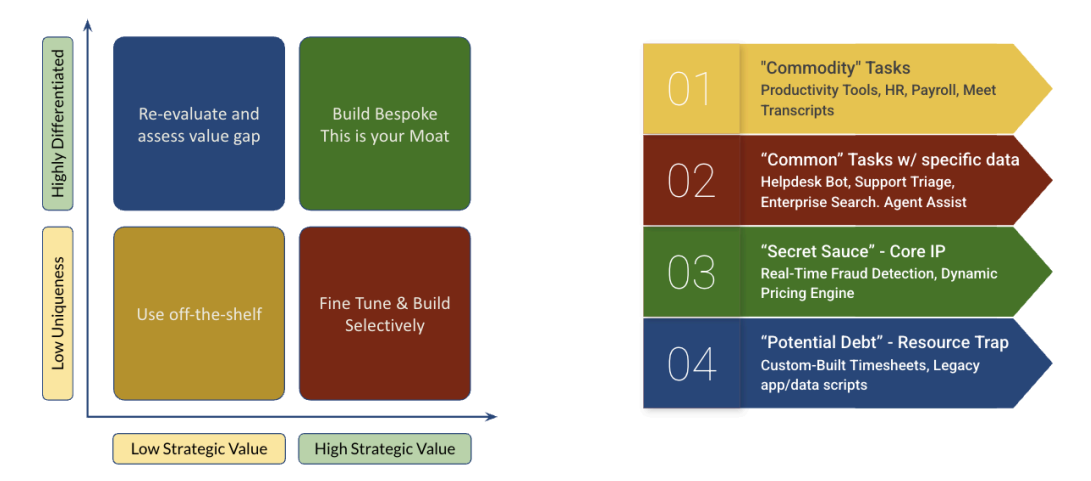
1. The Commodity Zone (Low Uniqueness, Low Strategic Value): For standard tasks like meeting transcripts, HR queries, or standard code generation, the path is clear - use off-the-shelf solutions. These are mundane problems and building custom solutions here is a misallocation of resources where the goal is parity, not differentiation.
2. The Optimization Zone (Low Uniqueness, High Strategic Value): For tasks like Enterprise Search or Support Triage, the mechanics are standard, but the content is specific. Here, we Fine-Tune & Build Selectively. We leverage a public models but wrap it in a proprietary RAG pipeline - standard architecture, proprietary context.
3. The Resource Trap (High Uniqueness, Low Strategic Value): This is the most dangerous quadrant. It includes projects that feel unique - like custom-built timesheets or legacy data scripting - but offer low strategic leverage. Engineers often gravitate here because the problems are idiosyncratic and interesting to solve. However, these initiatives often become technical debt that distracts from core innovation. The strategic imperative here is to re-evaluate.
4. The Moat (High Uniqueness, High Strategic Value): This is the "Secret Sauce," such as Real-Time Fraud Detection or Dynamic Pricing Engines. These problems are critical to the bottom line. This is where we Build Bespoke, deploy the best engineers, and orchestrate complex workflows.
Building this moat is a maturity curve moving from passive interaction to autonomous reasoning.
- Grounding (RAG): RAG bridges generic models with private data. By indexing data into a Vector Database, the model avoids generic advice and retrieves precise, citation-backed intelligence.
- Specializing (Fine-Tuning): When a model must learn a new language, such as a proprietary coding syntax or complex medical dialect, retrieval is insufficient. Engineers must choose techniques such as Parameter-Efficient Tuning (LoRA), which updates a small subset of parameters for efficiency, or Full Fine-Tuning, which is expensive but necessary for maximum quality on complex tasks
- Active Agentic Systems: The frontier lies in Agentic Systems, where the AI shifts from answering questions to executing workflows. An agentic system introduces a "Reasoning Loop": it pauses to think, breaks goals into sub-tasks, selects tools, and critiques its results. For example, in financial compliance, an agent can autonomously cross-reference entities, analyze news sentiment, and draft a Suspicious Activity Report, shifting the human analyst from "investigator" to "judge".
The winners of the next decade will not be those who merely subscribe to the smartest API, but those who build the most robust systems around it. In this new paradigm, we stop competing on the capabilities of the model - which we cannot control - and start competing on the quality of our context, which we exclusively own.